
Where does zakat money go?
Distribution totals are a starting point for understanding zakat institutions, not a complete account of every recipient.
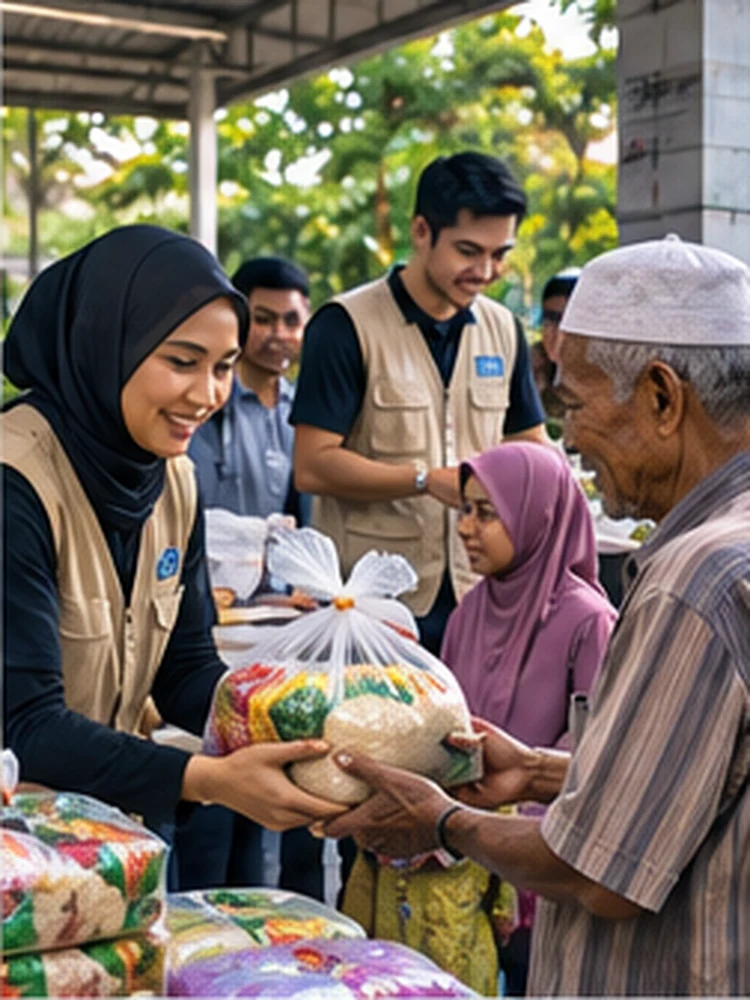
Zakat distributions across eight asnaf categories
Federal Territories distribution amounts for 2025, not population shares and not payments received by each person.
- Miskin (people in need)RM518.4 million
- Fakir (those in poverty)RM256.5 million
- FisabilillahRM237.4 million
- Amil (administration)RM163.2 million
- Gharimin (eligible debtors)RM62.1 million
- MuallafRM21.9 million
- RiqabRM16.3 million
- Ibnu SabilRM4 million
The eight category totals sum to exactly RM1,279,920,930. The source reports 169,728 in its total recipients column; that count is not used here to estimate individual assistance.
Collection and distribution are different series
JAWHAR publishes collection and distribution statistics supplied by state Islamic authorities and agencies. In 2025 the Federal Territories recorded roughly RM1.249 billion collected and RM1.280 billion distributed. Disbursement can involve funds carried over from other reporting periods, so the two figures need not match in a calendar year.
Who receives support
Zakat is distributed to eligible asnaf categories under state Islamic authorities' rules. State-specific reports are needed to verify distributions by category, programme and beneficiary. A national distribution total alone does not measure the success of each programme.
Do not fill blanks with guesses
Several 2025 state figures on JAWHAR's tables remain marked as being updated. PulseKita does not treat missing values as zero or rank all states as though coverage were complete. The historical record predates 2021: DOSM's Table 40.0 reports Malaysia-wide zakat collections of RM2,923,111,410 for 2017 and RM3,535,358,194 for 2020. Several state entries carry n.a. rather than RM0. DOSM's published national row is not the sum of the partially reported state entries.
Asnaf categories explain allocations
JAWHAR's 2025 Federal Territories table shows around RM518.4 million allocated to the miskin category, RM256.5 million to fakir, RM237.4 million to fisabilillah and RM163.2 million to amil. These are allocations by reported asnaf category, not the payment received by any one person. Other categories also received funding.
Beneficiary counts are not a poverty rate
JAWHAR reports 169,728 in the total recipients column for the Federal Territories in 2025. This administrative count is not a census of everyone living in poverty and should not be used to calculate assistance per person without understanding how recipients and programmes are recorded.
Documented example: Selangor's 2024 asnaf allocations
Lembaga Zakat Selangor's 2024 official statement records RM276,626,200 allocated to fakir and RM431,029,314 to miskin. Together these RM707,655,514 make up about 59.6% of Selangor's RM1,187,571,818 distribution total. Six other asnaf categories also received allocations. These figures are specific to Selangor, not a nationwide breakdown.
The 2025 report adds context on assisted families
LZS's 2025 announcement reports about RM1.31 billion in collections, RM1.33 billion in distributions, and 80,022 families receiving assistance. The billion-ringgit figures are rounded, and family counts are not interchangeable with individual beneficiary counts in other states. PulseKita therefore presents this as sourced context, not exact inputs for a bar race. In Sabah, MUIS reports RM182,135,889.76 distributed in 2025, while the Melaka Islamic Religious Council (MAIM) reports RM160,077,622 for the same year. These state totals must not be conflated with LZS family counts or interpreted as assistance per resident. Separately, JAWHAR's Johor 2025 asnaf table reports RM77.45 million for fakir and RM145.63 million for miskin, about 52.8% of Johor's RM422.60 million total distributions. This 2025 Johor mix is not directly comparable with Selangor's 2024 mix because years and state programmes differ.