
Skip to content
HomeMalaysia's History

MALAYSIA'S HISTORY · CHAPTER 01

Before the name Malaya, these lands already had stories.

Our story begins with stone tools, caves and human lives: from Perak to Sarawak and Sabah, then early trade and writing, long before the modern Malaysian state was formed.

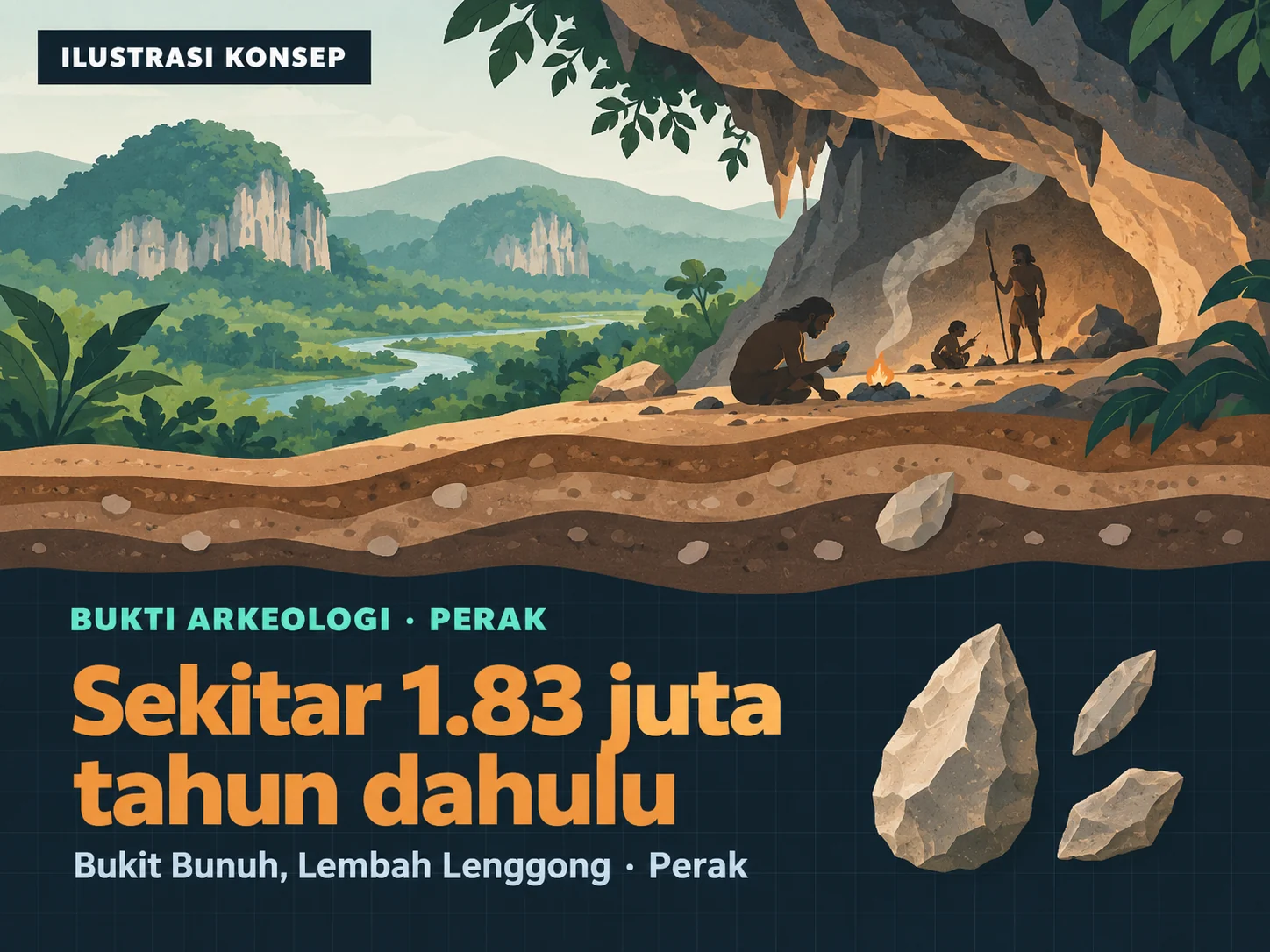
AI concept illustration of Lenggong: cave, tropical landscape, symbolic stone tools and imagined prehistoric figures; not a real photograph or archaeological reconstruction.
CONCEPT ILLUSTRATIONAround 1.83 million years agoBukit Bunuh, Lembah Lenggong · Perak

Stone tools reshape the region's earliest history

AI-generated conceptual artwork only. People, cave, stone tools and soil layers are not reconstructions of this site. Stone-tool evidence does not establish the appearance or identity of ancient people; dates are source-based estimates.
PULSEKITA / HISTORY TIMELINE

The history behind each documented moment

CHAPTER 01
Around 1.83 million years agoStone tools reshape the region's earliest history

Bukit Bunuh, Lembah Lenggong · Perak

1 / 8 records

Only source-backed milestones appear here. Approximate periods remain approximate; these are not documentary reconstructions. Open the full event for evidence and interpretation limits.

PeninsulaLenggong, ancient Kedah, Terengganu
SarawakNiah and rainforest life
SabahSemporna pottery and sea connections
How to read early history

Modern state and regional names locate the sites, not ancient political borders. Site ages are estimates; artefacts do not by themselves identify ethnicity, language or a kingdom.

SECTION 01

Traces of early humans

Stone tools, caves and ancient burials before written records.

Around 1.83 million years agoBukit Bunuh, Lembah Lenggong · Perak

Stone tools reshape the region's earliest history

Stone-tool workshops and geological deposits at Bukit Bunuh provide exceptionally early evidence associated with hominins in Southeast Asia. UNESCO describes an archaeological sequence extending to around 1.83 million years.

Sources and interpretation limits2 sources

Important limitation: Dating the site and tools does not establish a particular human species, a Malay language community or a Malaysian state.

Around 70,000 years agoKota Tampan, Lenggong · Perak

Stone-tool workshops and the Toba eruption

Kota Tampan preserves stone-tool production evidence. Its dating is associated with deposits from the Toba volcanic eruption, helping archaeologists reconstruct a deep sequence.

Sources and interpretation limits1 sources

Important limitation: Around 70,000 years is an archaeological estimate, not an exact calendar date or proof of why every inhabitant moved.

At least 50,000 years agoKompleks Gua Niah · Sarawak

People living with Borneo's rainforest

The Niah cave complex documents human interaction with rainforest environments for at least 50,000 years, with evidence of occupation, funerary traditions and cave art.

Sources and interpretation limits2 sources

Important limitation: Niah is in present-day Sarawak; the archaeological record predates the modern state boundaries.

Around 10,000 years agoGua Gunung Runtuh, Lenggong · Perak

Perak Man's burial reveals prehistoric life

Perak Man was discovered at Gua Gunung Runtuh. The burial offers evidence about prehistoric funerary practices on the peninsula.

Sources and interpretation limits2 sources

Important limitation: UNESCO reports a radiocarbon date around 10,120 years before present; the rounded date is not an exact birth year.

SECTION 02

Communities and technologies

Metalworking, pottery and communities on both sides of the South China Sea.

Around 4,000–3,500 years agoGua Harimau, Lenggong · Perak

Early bronze artefacts and burials

The Department of National Heritage documents a bronze axe and ceramic mould from a burial at Gua Harimau, indicating metalworking-related knowledge in prehistory.

Sources and interpretation limits1 sources

Important limitation: An artefact alone does not prove a kingdom or a large-scale local metal industry.

Around 3,000 years agoBukit Tengkorak, Semporna · Sabah

Bukit Tengkorak pottery and early maritime connections

Thousands of Neolithic pottery fragments have been found at Bukit Tengkorak. Materials including obsidian suggest connections across island Southeast Asia.

Sources and interpretation limits2 sources

Important limitation: Continuities in pottery techniques among Bajau communities today do not establish the precise identities of residents three millennia ago.

SECTION 03

Trade and writing

Ports, ironworking and the development of writing and religious traditions.

Around the 1st century CESungai Batu dan Lembah Bujang · Kedah

Iron, rivers and organised communities in ancient Kedah

Excavations around Sungai Batu and the Bujang Valley document iron smelting, riverside structures and religious remains, indicating production and wider connections long before the Melaka Sultanate.

Sources and interpretation limits1 sources

Important limitation: Early Sungai Batu dating remains under research. This chapter uses the broad range described by the national heritage authority, not a disputed superlative date.

1303 CEKuala Berang · Terengganu

The Terengganu inscription records Jawi and religious life

The Terengganu Inscribed Stone provides early evidence of Jawi writing and Islamic legal and cultural life in the Malay world during the fourteenth century.

Sources and interpretation limits3 sources

Important limitation: The inscription documents one place and period; it does not imply that all communities across the region shared a single religion.

CONTINUE THE STORY

How did polities and kingdoms lead to modern Malaysia?

The next chapters follow distinct regional histories. The Federation of Malaya's independence in 1957 is not the same event as Malaysia's formation in 1963.

02

Early polities and regional networks

Ancient Kedah, Langkasuka, Srivijaya, Santubong, Brunei and early Melaka — with regional evidence.

Read Chapter 2 →
03

Foreign powers and colonial rule

Portuguese, Dutch, British and Japanese eras through 1946 — distinct histories of the peninsula, Sabah and Sarawak.

Read Chapter 3 →
04

Independence and the formation of Malaysia

Distinguishing the Federation of Malaya's independence on 31 August 1957 from Malaysia's formation on 16 September 1963.

Read Chapter 4 →
05

Malaysia since 1963

From Singapore's separation to education, economic change, unity and civic movements in the 1990s.

Read Chapter 5 →
06

Malaysia in the 21st century

Sourced developments from 2001 to 2026, including disasters, aviation, elections, the pandemic and the digital economy.

Read Chapter 6 →
Sources link directly to the claims they support; estimates and interpretive limits are disclosed.