Skip to content

MALAYSIA HISTORY · CHAPTER 03

Outside powers came and went. People's histories never stopped.

From Melaka's capture in 1511 to the postwar transitions of 1946, the peninsula, Sarawak and Sabah followed different paths, not one uniform colonial timeline.

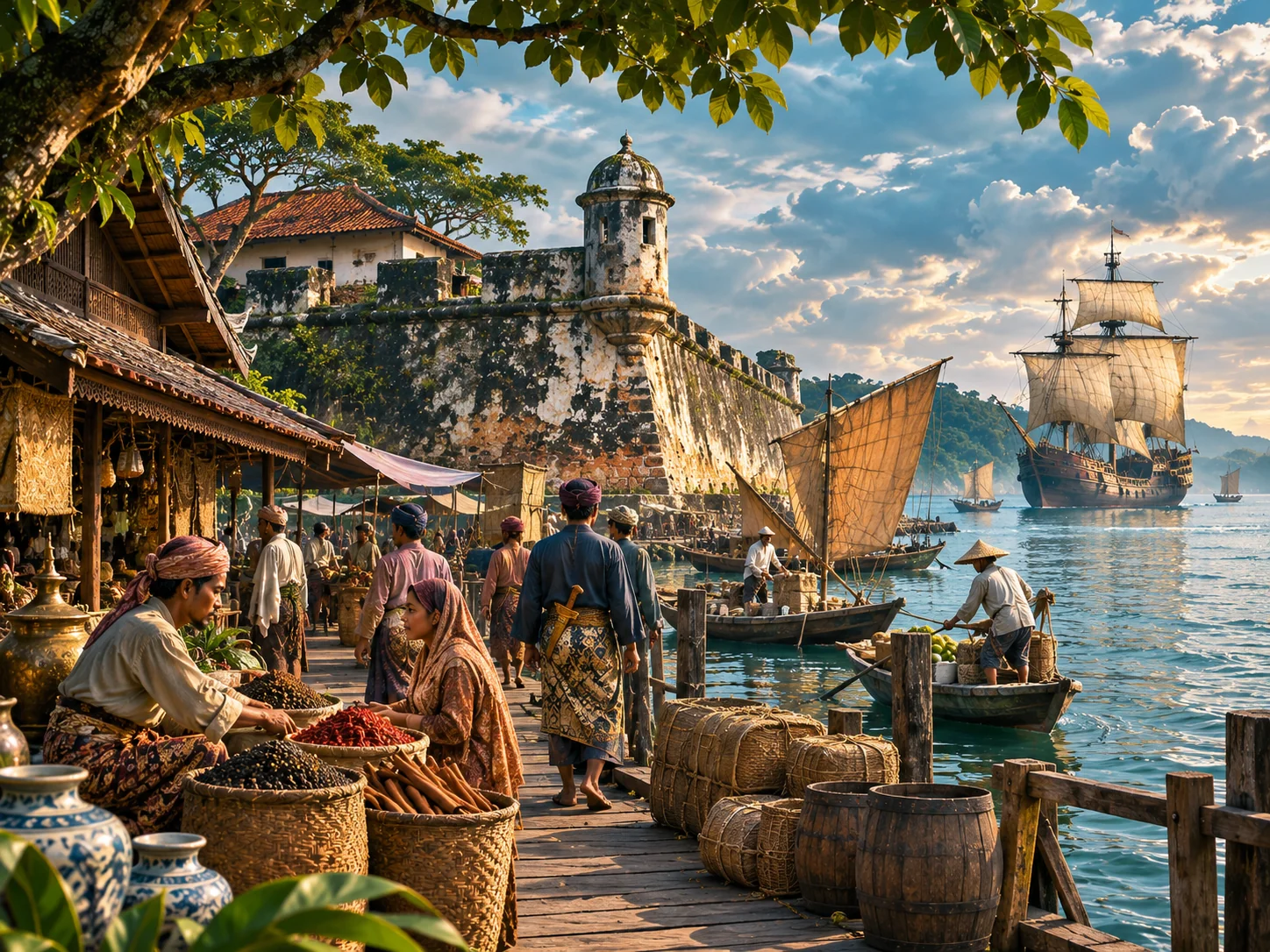
AI concept illustration of Melaka port with traders, sailing ships and a stone fort in the era of foreign powers; not a historical photograph or verified site reconstruction.
AI CONCEPT ILLUSTRATION11 sourced records
FIRST RECORD IN THIS CHAPTER1511 CEMelaka · port city

Portuguese forces capture Melaka, not the whole peninsula

AI-generated thematic illustration of foreign influence. The harbour, figures, ships and fort are imagined, not an accurate depiction of 1511 or evidence of uniform rule over the peninsula, Sabah and Sarawak.
PULSEKITA / HISTORY TIMELINE

The history behind each documented moment

CHAPTER 03
1511 CEPortuguese forces capture Melaka, not the whole peninsula

Melaka · port city

1 / 11 records

Only source-backed milestones appear here. Approximate periods remain approximate; these are not documentary reconstructions. Open the full event for evidence and interpretation limits.

Document ≠ popular consent

A change of control in Melaka did not automatically colonise the entire peninsula. Malay states, Sarawak and North Borneo experienced different treaties and forms of governance; modern place names are geographical guides, not historical jurisdiction.

SECTION 01

Forts, ports and treaties

Changing authority in Melaka and British footholds unfolded in different locations and decades.

1511 CEMelaka · port city

Portuguese forces capture Melaka, not the whole peninsula

Forces led by Afonso de Albuquerque captured the port of Melaka in 1511. The city's administration changed, while other Malay polities and communities continued their separate political histories beyond its walls.

Review sources and interpretation limits2 sources

Evidence type: written accounts

Interpretation limit: The conquest of one port cannot be treated as Portuguese rule over all Malay states, Sabah or Sarawak. Evidence applies to the territories explicitly described.

1641 CEMelaka · Straits of Melaka

Dutch forces take control of Melaka

In January 1641 Dutch forces took Melaka from the Portuguese. This shifted European control of the city and its strategic port, but it did not extinguish other Malay sultanates or local political systems.

Review sources and interpretation limits1 sources

Evidence type: written accounts

Interpretation limit: Do not represent 1641 as Dutch conquest of all Malaya. City control and trading influence are not the borders of modern Malaysia.

1786 CE; mainland Seberang Perai in 1800Penang Island and Seberang Perai · formerly linked to Kedah

Penang becomes an early British foothold

The English East India Company established control on Penang Island in 1786 and obtained Seberang Perai by agreement in 1800. Penang state records also document Malay settlements predating British arrival.

Review sources and interpretation limits2 sources

Evidence type: written accounts

Interpretation limit: Calling Penang 'founded' by Francis Light does not mean it was uninhabited. Earlier settlement and Kedah treaties must remain visible.

1824 CEMelaka, Singapore and the Straits

Anglo-Dutch treaty reshapes spheres of influence

The 1824 Anglo-Dutch Treaty rearranged European spheres of influence around the Straits, including Melaka's position. An agreement between European powers affected regional politics without instantly making every Malay state a British colony.

Review sources and interpretation limits1 sources

Evidence type: written accounts

Interpretation limit: The 1824 treaty did not automatically place every Malay state under British administration. Protected states, resident systems and colonies developed separately.

SECTION 02

Different systems across regions

Malay states, Sarawak and North Borneo were never one uniform colonial administration.

Approximately 1841–1842Sarawak River basin · Borneo

Sarawak enters the Brooke era

James Brooke acquired authority around the Sarawak River in 1841, with official accounts also describing his installation in 1842. His territory expanded over later decades, while Malay, Bidayuh, Iban and other societies had their own local histories and responses.

Review sources and interpretation limits2 sources

Evidence type: written accounts

Interpretation limit: Do not depict all of present-day Sarawak as Brooke territory in 1841, or assume every community supported his rule. Territorial control evolved.

1874 CE; subsequent expansionPerak, later other Malay states

Pangkor Agreement and expansion of the Resident system

The 1874 Pangkor Agreement was a turning point in British intervention in Perak's administration through the Resident system. Similar arrangements spread unevenly, while Malay rulers and local structures continued under changing constraints.

Review sources and interpretation limits2 sources

Evidence type: written accounts

Interpretation limit: British authority was not uniform and the Malay monarchies were not abolished in 1874. Distinguish protected states, direct colonial rule and Resident advice.

1881–1942; chartered-company periodNorth Borneo · present-day Sabah

A chartered company governs North Borneo

The British North Borneo Chartered Company received a royal charter in 1881 and administered North Borneo until the Japanese invasion in 1942. This corporate form of government differed from direct Crown Colony rule and did not erase indigenous societies.

Review sources and interpretation limits2 sources

Evidence type: written accounts

Interpretation limit: The royal charter documents a company's authority following earlier agreements; it is neither the beginning of Sabah's history nor proof of universal local consent.

1896 CE; Federal Council in 1909Perak, Selangor, Negeri Sembilan and Pahang

Federated Malay States are formed

In 1896 Perak, Selangor, Negeri Sembilan and Pahang formed the Federated Malay States under British administrative arrangements. Other Malay states remained outside this federation, and later changes unfolded at different times.

Review sources and interpretation limits1 sources

Evidence type: written accounts

Interpretation limit: The federation of 1896 was neither the Federation of Malaya established in 1948 nor Malaysia formed in 1963. These are distinct political entities.

SECTION 03

War and contested transitions

Japanese occupation and postwar political arrangements prompted new popular responses.

December 1941–1945 (regional chronology)Peninsula, Sarawak and North Borneo

Japanese occupation brings different wartime experiences

Japanese attacks began in Malaya in December 1941, with landings recorded in Sarawak that month and North Borneo affected later. Civilian experiences, wartime rule and resistance differed by locality and community.

Review sources and interpretation limits3 sources

Evidence type: written accounts

Interpretation limit: Do not assign one occupation date to every territory: Malaya's full occupation began in February 1942 while Borneo followed different sequences. The war's impact was not uniform.

1 April 1946; Federation of Malaya in 1948Malay states and certain former Straits Settlements

Malayan Union sparks political debate and opposition

Britain introduced the Malayan Union on 1 April 1946 following World War II. Opposition spurred political mobilisation including UMNO, before replacement by the Federation of Malaya in 1948. Other political movements also formed part of this history and deserve fuller treatment in Chapter 4.

Review sources and interpretation limits2 sources

Evidence type: written accounts

Interpretation limit: The Malayan Union did not cover Sabah or Sarawak, and political opinion in Malaya was not unanimous. Left-wing and labour movements were also active.

Sarawak 1 July 1946; North Borneo 15 July 1946Sarawak and North Borneo · distinct transitions

Sarawak and North Borneo become Crown Colonies

After the war Sarawak became a British Crown Colony on 1 July 1946, and North Borneo on 15 July. Sarawak's cession sparked opposition including women's participation; Sabah moved from chartered-company administration to direct colonial rule.

Review sources and interpretation limits3 sources

Evidence type: written accounts

Interpretation limit: These dates did not incorporate Sabah and Sarawak into the Federation of Malaya or confer independence in 1946. Local political responses differed.

People's histories are not just government histories

Treaties, charters and port transfers track formal power, not every people's experience. Malay and indigenous societies, Chinese, Indian and other communities—including women, workers, farmers and traders—have distinct histories. In Sabah and Sarawak local custom, resistance, economies and diversity cannot be reduced to British administration alone. This chapter separates documentary authority from claims of popular consent.

Kerajaan Negeri Pulau Pinang ↗ · Jurnal Muzium Sarawak ↗ · Kerajaan Negeri Sabah ↗

WHAT COMES NEXT

Chapter 4 · Independence and the Formation of Malaysia

Explore political movements, independence negotiations, Sabah and Sarawak perspectives, and the Malaysia Agreement 1963.

Read Chapter 4: Independence and Malaysia →
Every claim includes source links and interpretation limits. Territories and communities were not governed by one uniform colonial state.