
Skip to content

MALAYSIA HISTORY · CHAPTER 04

Malaya became independent in 1957. Malaysia formed in 1963. Two dates, many regional journeys.

Independence was not one speech or one organisation. It involved popular movements, negotiations, elections, and the voices of Sabah and Sarawak in forming Malaysia.

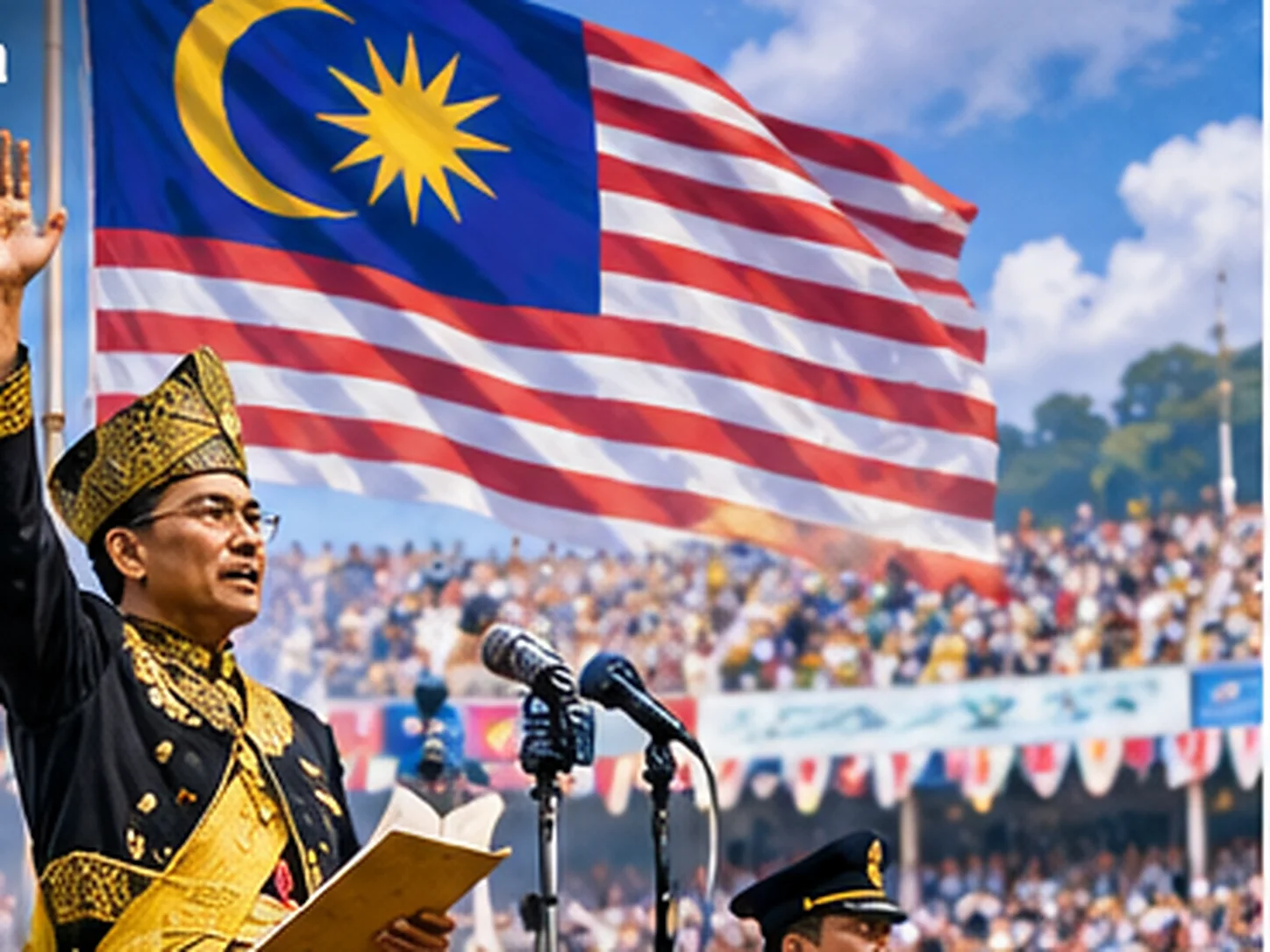
AI concept illustration of an independence rally with flag and an imagined speaker; not a real photograph or verified portrait of any historical figure.
AI CONCEPT ILLUSTRATION13 sourced records
FIRST RECORD IN THIS CHAPTER1946–1947Emerging Malayan federation · Peninsula

Many political voices contest Malaya's future

AI-generated illustration; the speaker, clothing and stage do not document any specific event or identifiable person. Malayan independence on 31 August 1957 is distinct from Malaysia's formation on 16 September 1963. Follow the sources below for dates and regional perspectives.
PULSEKITA / HISTORY TIMELINE

The history behind each documented moment

CHAPTER 04
1946–1947Many political voices contest Malaya's future

Emerging Malayan federation · Peninsula

1 / 13 records

Only source-backed milestones appear here. Approximate periods remain approximate; these are not documentary reconstructions. Open the full event for evidence and interpretation limits.

31 August 1957 ≠ 16 September 1963

The Federation of Malaya became independent on 31 August 1957. Malaysia formed on 16 September 1963 with Sabah, Sarawak and Singapore. Borneo views were canvassed through inquiries and negotiations, not one identical direct-ballot referendum across every territory.

SECTION 01

Political voices and popular demands

The independence movement involved varied organisations and approaches, not a single voice.

1946–1947Emerging Malayan federation · Peninsula

Many political voices contest Malaya's future

Alongside UMNO and Malay rulers' opposition to the Malayan Union, the AMCJA and PUTERA coalitions advanced alternative political demands, involving workers, young activists and women's organisations such as AWAS. Independence politics included contested ideas of representation and citizenship.

Review sources and interpretation limits1 sources

Evidence type: historical records and official documents

Interpretation limit: Coalition members did not share one organisation or ideology. Archive accounts record these movements without showing that every demand was accepted or every member agreed.

1 February 1948Peninsula · excluding Sabah and Sarawak

Federation of Malaya replaces the Malayan Union

The Malayan Union was replaced by the Federation of Malaya on 1 February 1948 after political opposition and negotiations. Different organisations held different views of the new constitutional arrangement.

Review sources and interpretation limits1 sources

Evidence type: historical records and official documents

Interpretation limit: The federation of 1948 was neither independence in 1957 nor Malaysia's formation in 1963. Sabah and Sarawak were not members of this 1948 federation.

1948–1960Federation of Malaya · Peninsula

The Emergency reshapes civilian life and politics

The Emergency began in 1948 amid armed attacks and conflict between communist guerrillas and authorities. Civilians experienced insecurity and security restrictions; the Emergency lasted until 1960, beyond Malayan independence in 1957.

Review sources and interpretation limits1 sources

Evidence type: historical records and official documents

Interpretation limit: The Emergency did not unfold identically across all of present-day Malaysia. Distinguish armed violence, constitutional political movements and civilian experiences.

SECTION 02

Towards independence in 1957

Elections, negotiations and constitutional change led to the Federation of Malaya's independence.

27 July 1955Federation of Malaya

Federal elections open a path to self-government

The 1955 federal election gave the Alliance 51 of the 52 elected seats. Tunku Abdul Rahman became Chief Minister, marking a significant step towards self-government through electoral institutions.

Review sources and interpretation limits2 sources

Evidence type: historical records and official documents

Interpretation limit: The 52 elected seats were not the entire legislature: other members were appointed or represented designated interests. The vote did not include Sabah and Sarawak.

8 February 1956London, United Kingdom · Federation of Malaya

London negotiations set the course for 31 August 1957

A Malayan delegation negotiated with the British government in London. The agreement of 8 February 1956 set 31 August 1957 for Malayan independence, followed by constitutional negotiations and preparations for transferring authority.

Review sources and interpretation limits2 sources

Evidence type: historical records and official documents

Interpretation limit: The 1956 negotiation agreement was not itself independence in 1957 and did not include Sabah or Sarawak. Constitutional work still followed.

31 August 1957Stadium Merdeka, Kuala Lumpur · Federation of Malaya

The Federation of Malaya attains independence

On 31 August 1957 the Federation of Malaya proclaimed independence at Stadium Merdeka. Tunku Abdul Rahman read the proclamation and led the Merdeka call. This was a pivotal event, six years before the formation of Malaysia.

Review sources and interpretation limits2 sources

Evidence type: historical records and official documents

Interpretation limit: 31 August 1957 marks the Federation of Malaya's independence, not the date Sabah, Sarawak and Singapore entered Malaysia. It must not be conflated with 16 September 1963.

SECTION 03

Negotiating Malaysia's formation

The proposed federation raised questions of consultation and safeguards in Sabah, Sarawak and Singapore.

27 May 1961; consultations 1961–1962Singapore and proposed member territories

Malaysia proposal prompts cross-regional consultations

On 27 May 1961 Tunku Abdul Rahman proposed political cooperation involving Malaya, Singapore, North Borneo, Sarawak and Brunei. The subsequent Malaysia Solidarity Consultative Committee convened representatives of different territories.

Review sources and interpretation limits1 sources

Evidence type: historical records and official documents

Interpretation limit: A proposal was not automatic agreement by every community or ruler. Brunei did not become a party to the 1963 Malaysia Agreement; Singapore joined in 1963 and separated in 1965.

January–August 1962North Borneo (Sabah) and Sarawak

Cobbold Commission examines Borneo perspectives

The Cobbold Commission was established in January 1962 and held hearings in North Borneo and Sarawak from February to April. Its report informed negotiations and proposals to safeguard local interests during Malaysia's formation.

Review sources and interpretation limits2 sources

Evidence type: historical records and official documents

Interpretation limit: Interviews and memoranda were not a universal direct-ballot referendum. Support percentages depend on the inquiry's method and must not be presented without that context.

1962–1963 (Inter-Governmental Committee report)Malaya, North Borneo and Sarawak

Negotiations address Borneo safeguards and powers

The Inter-Governmental Committee considered constitutional arrangements and safeguards for North Borneo and Sarawak, including regional powers and administrative responsibilities in the proposed federation. Its report is central to understanding Malaysia's formation.

Review sources and interpretation limits2 sources

Evidence type: historical records and official documents

Interpretation limit: The '20-point' and '18-point' proposals belong to historical demands and negotiations; they are not automatically identical to every provision eventually enacted in law.

SECTION 04

1963: agreement, self-government and Malaysia

The Malaysia Agreement, Borneo self-government milestones and 16 September must be kept distinct.

9 July 1963London · five contracting parties

Malaysia Agreement 1963 is signed

The Malaysia Agreement was signed in London on 9 July 1963 by Britain, the Federation of Malaya, North Borneo, Sarawak and Singapore. The United Nations treaty record gives its entry into force as 16 September 1963.

Review sources and interpretation limits2 sources

Evidence type: historical records and official documents

Interpretation limit: The agreement's signature date is not Malaysia's formation date. Brunei was not a signatory. State safeguards require examining the agreement, annexes and relevant legal provisions.

22 July 1963Kuching, Sarawak

Sarawak forms self-government ahead of Malaysia

On 22 July 1963 Stephen Kalong Ningkan was appointed Sarawak's first Chief Minister and a Supreme Council was formed. The date is commemorated as Sarawak Day and marks a significant self-government milestone before Malaysia's formation in September.

Review sources and interpretation limits3 sources

Evidence type: historical records and official documents

Interpretation limit: The claim of full legal independence on 22 July is contested; state sources distinguish self-government on 22 July from the later end of British sovereignty on 16 September. This distinction must remain visible.

31 August 1963North Borneo (Sabah)

Sabah Day commemorates the 1963 transition

Sabah commemorates 31 August 1963 as Sabah Day, linked to the end of British colonial rule and its path to self-government. Sabah's government revived official celebrations, while Malaysia was formed on 16 September of the same year.

Review sources and interpretation limits2 sources

Evidence type: historical records and official documents

Interpretation limit: Official Sabah statements use both 'independent nation' and 'self rule' in different contexts. Do not equate a commemorative label with a settled legal conclusion about every constitutional power on 31 August.

16 September 1963Federation of Malaya, Sabah, Sarawak and Singapore

Malaysia is formed on 16 September 1963

Malaysia was formed on 16 September 1963 with the Federation of Malaya, Sabah (North Borneo), Sarawak and Singapore. This differs from Malaya's independence on 31 August 1957; Singapore subsequently separated in 1965.

Review sources and interpretation limits4 sources

Evidence type: historical records and official documents

Interpretation limit: Consultations and reports on Malaysia's formation were not a single identical direct-ballot referendum across every territory. 16 September marks treaty entry into force and the formation of the new federation.

Two national dates, different regional experiences

31 August 1957 is the independence of the Federation of Malaya, while 16 September 1963 marks Malaysia's formation. Sabah and Sarawak contributed distinct social histories, political movements, constitutional negotiations and safeguards. Sarawak commemorates 22 July for self-government and Sabah observes 31 August as Sabah Day. The federation's creation must not be presented as one nationwide direct referendum.

United Nations Treaty Collection ↗ · Pejabat Premier Sarawak ↗ · Pejabat Ketua Menteri Sabah ↗

WHAT COMES NEXT

Chapter 5 · Malaysia Since 1963

Continue into economic, social and political change, including regional development and civic voices after Malaysia formed.

Read Chapter 5: Malaysia Since 1963 →
Every milestone includes sources and interpretation limits. Malayan independence and Malaysia's formation were distinct historical processes.